What Are DeFi, DEXs and Liquidity Pools?
DeFi (decentralized finance) is the set of financial services that run on smart contracts, with no bank or broker in the middle. A DEX is a decentralized exchange, where you swap tokens straight from your wallet. And a Liquidity Pool is the "inventory" of tokens that makes those swaps possible — supplied by everyday people, who earn a share of the fees in return.
What is DeFi (decentralized finance)
DeFi is short for Decentralized Finance. Instead of a company holding your money and executing transactions, the rules live in smart contracts published on the blockchain, open and auditable. Anyone with a wallet can use them, 24 hours a day, with no sign-up.
Token swaps, lending, yield and liquidity provision are some of the most widely used DeFi services.
What is a DEX (decentralized exchange)
DEX stands for Decentralized Exchange. On a traditional exchange, you deposit your tokens and the company handles the orders. On a DEX, you connect your wallet, make the swap, and the tokens go straight back to you — the DEX never takes custody of your funds.
Uniswap (available on many networks) and Aerodrome (the leading DEX on the Base network) are two of the best-known examples.
What is a Liquidity Pool
A DEX doesn't have buyers and sellers waiting in an order book. Instead, it uses pools: contracts that hold two tokens, such as ETH and USDC. Someone who wants to swap ETH for USDC puts ETH into the pool and takes USDC out, at a price calculated by a formula.
Every swap pays a fee — for example, 0.05% or 0.3% of the amount. That fee is distributed among the people who supplied the pool's tokens.
What is a Liquidity Provider (LP)
A Liquidity Provider is the person who deposits both tokens into the pool. In return, they receive a share of the fees from every trade, proportional to the liquidity they provide. On some DEXs, like Aerodrome, LPs can also earn rewards in the protocol's tokens.
A simple example: if a pool handles $1 million a day with a 0.3% fee, it generates $3,000 in daily fees, split among LPs according to each one's share.
The risks of being a liquidity provider
- Volatility: the tokens in your position can lose value.
- Impermanent Loss: when the prices of the two tokens drift apart, the pool rebalances your position, and the result can end up worse than simply holding the tokens.
- Going out of range: with concentrated liquidity, if the price leaves your chosen range, the position stops earning fees.
- Contract risk: bugs in the protocol's code.
Why you should track your positions
Looking at your token balance alone doesn't tell you whether a position is profitable. You need to compare the capital you deposited, the current value, the fees earned and what you would have if you had simply held the tokens. With multiple positions across multiple DEXs, doing this by hand quickly turns into an endless spreadsheet.
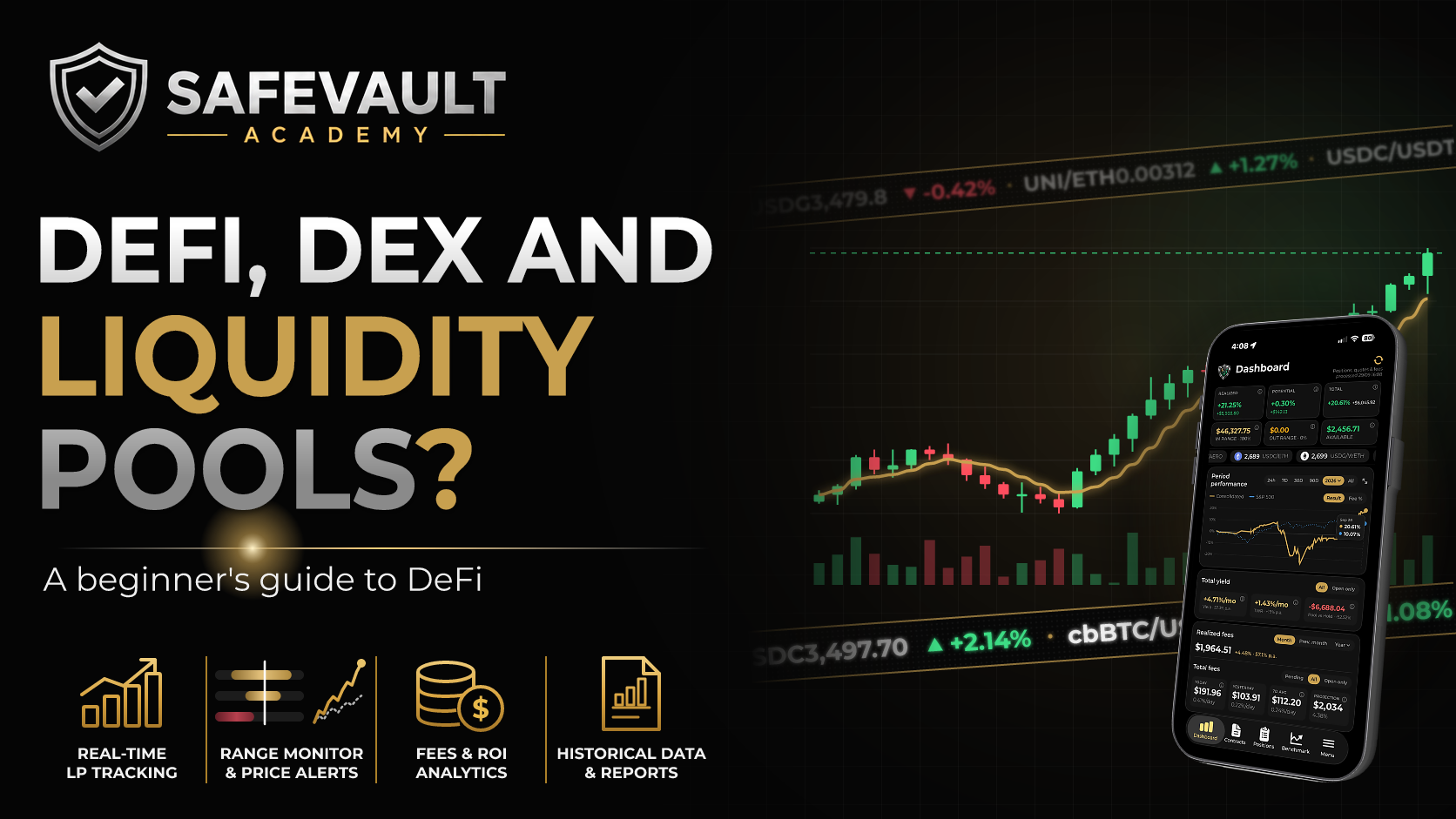
That's exactly what the SafeVault Performance Tracker is for: it brings your Uniswap and Aerodrome positions together in a single view, showing the capital, current value, fees and return of each one.
Frequently asked questions
Do I need a lot of money to be a liquidity provider?
No. Most pools accept any amount, but network fees (gas) weigh more heavily on small positions, especially on Ethereum.
Is a DEX safer than a centralized exchange?
It removes the exchange's custody risk, but it adds smart contract risk and requires you to take care of your own wallet.
Are pool returns guaranteed?
No. Fees depend on trading volume, and token prices can drop. Your results need to be tracked.
Conclusion
DeFi is the ecosystem, a DEX is the decentralized exchange, and a Liquidity Pool is the mechanism that makes swaps happen. Those who provide liquidity become part of that infrastructure and get paid for it.
Understanding these three concepts is the first step. The second is learning to measure whether your position is actually paying off.